


TECHNIQUE
Frenzel Maneuver for Freediving: How to Equalise Your Ears and Dive Deeper in Lanzarote
If you are learning to freedive, there is a good chance that one skill will determine how comfortable your first metres underwater feel: equalisation.
CHRISTIAN VOGLER · 11 AUGUST 2026 · 8 MIN READ
FFor many beginners, holding their breath is not actually the main obstacle. Their ears are.
The Frenzel maneuver is one of the fundamental equalisation techniques used in freediving. Learning it correctly can make your descents more relaxed, efficient and controlled—and help you progress without trying to force your way through pressure.
At Apnea Lanzarote, we work with beginners and experienced freedivers on equalisation, relaxation, diving technique and depth progression during our freediving courses and coaching sessions in Lanzarote. Our current programmes include AIDA, SSI and FFESSM/CMAS freediving courses as well as dedicated equalisation training.
If you are looking for a freediving instructor in Lanzarote, want to take a freediving course in Spain, or simply want to improve your Frenzel before freediving in Puerto del Carmen, this guide will help you understand what is happening behind the technique.
What is the Frenzel maneuver?
The Frenzel maneuver is an equalisation technique used to increase pressure in the middle ear during descent.
As a freediver descends, the surrounding water pressure increases. The air spaces in the middle ears need to be equalised with the surrounding pressure. Equalisation techniques allow air to reach the middle ear through the Eustachian tubes.
With Frenzel, instead of generating pressure primarily from the lungs, the freediver closes the glottis and uses the tongue as a piston to compress air in the mouth and throat.
A simple way of visualising the movement is to think about making a silent “K” or “T” sound while the nose is pinched.
DAN describes Frenzel as closing the nostrils and throat and using a “K”-type tongue movement to compress air towards the Eustachian tubes.
The movement is small.
And that is precisely why learning Frenzel can initially be frustrating: the important part of the technique happens inside your mouth and throat, where you cannot easily see it.
A simple way of visualising the movement is to think about making a silent “K” or “T” sound while the nose is pinched.
— CHRISTIAN VOGLER
Why is Frenzel important for freediving?
Many people instinctively equalise using the Valsalva maneuver: they pinch their nose and create pressure by attempting to exhale against the closed nostrils.
That technique can work near the surface, but it depends much more heavily on pressure generated from the respiratory system.
Frenzel is different.
Because the pressure is generated mainly with the tongue and upper airway, Frenzel can be performed without relying on a large contraction of the chest or abdominal muscles.
For a freediver, that has important advantages:
- less unnecessary muscular effort during descent;
- better relaxation;
- more precise control of equalisation;
- easier repetitive equalisation;
- a foundation for more advanced equalisation techniques later in your freediving development.
AIDA includes equalisation as part of the fundamental skills taught in its freediving education system, including its introductory and AIDA 2 programmes.
FREEDIVING TIP
Practise five minutes of dry equalisation every morning. Consistency beats intensity — twenty short sessions a month will do more for your depth than one long pool session.
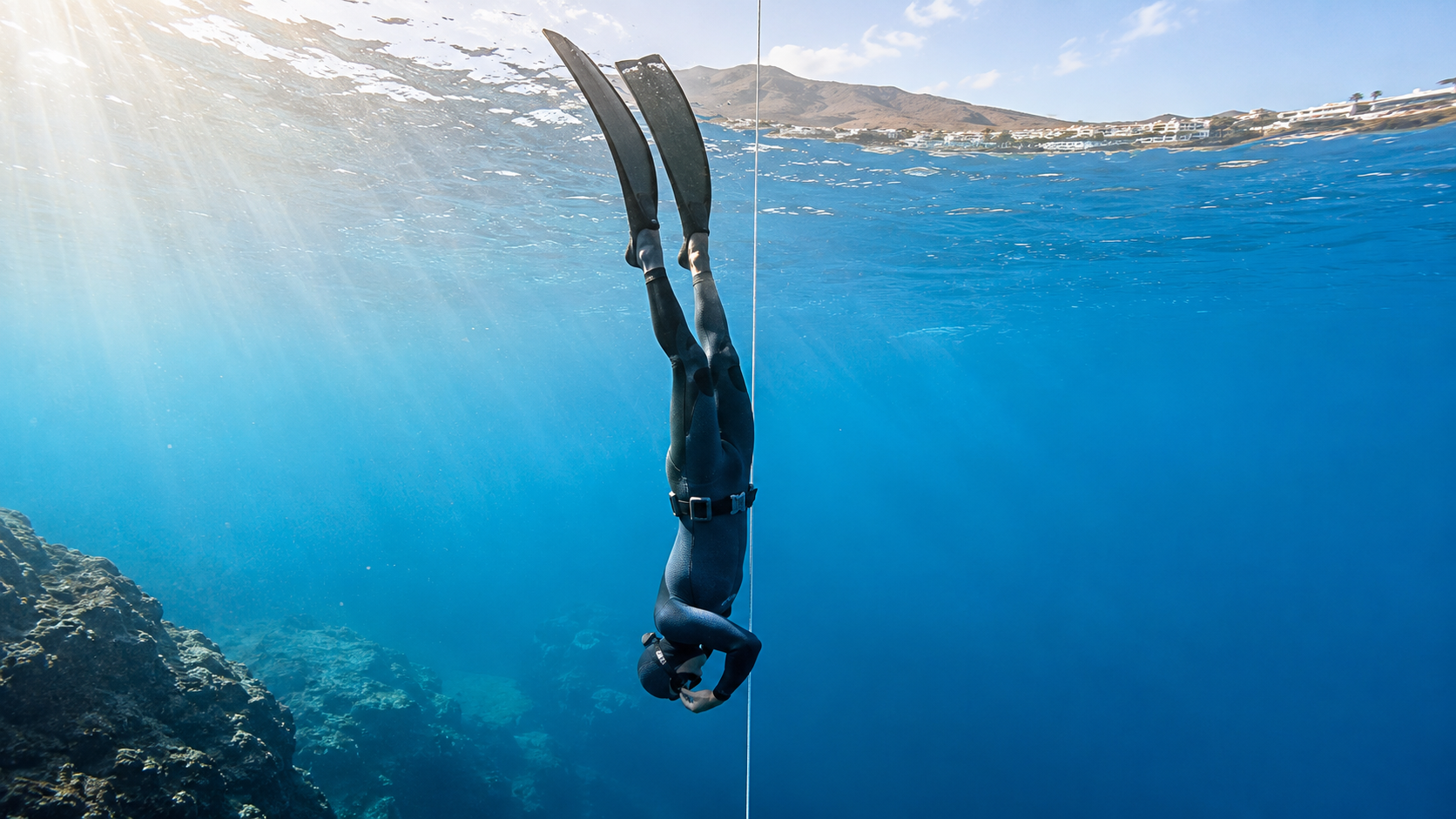
Depth sessions off the east coast of Lanzarote, where flat water and easy access allow daily progression.
Frenzel vs Valsalva: what is the difference?
Although both techniques aim to equalise pressure in the middle ear, the way they generate pressure is different.
Valsalva
With Valsalva, you pinch your nose and gently attempt to exhale through it.
The pressure originates largely from the lungs and respiratory muscles.
Frenzel
With Frenzel, you:
- pinch or close your nose;
- close the glottis;
- position the tongue appropriately;
- move the tongue upward like a piston.
The resulting compression of air helps equalise the middle ears.
The easiest clue when practising on land is often what isn’t moving.
If your abdomen and chest are working hard every time you equalise, you may still be using Valsalva rather than a clean Frenzel technique.
How to practise the Frenzel maneuver
Frenzel can—and should—first be explored in a controlled environment on dry land.
Try the following exercise.
1. Learn to recognise your glottis
Your glottis controls airflow between your lungs and upper airway.
Try holding your breath with your mouth open.
The sensation of closing the airway in your throat helps you begin recognising glottis control.
2. Find the tongue movement
Say:
“K, K, K.”
Now repeat the same movement silently.
Notice how the rear part of your tongue moves upward.
You can also experiment with a “T” position, which involves a slightly different tongue placement and can be useful as your equalisation develops.
3. Pinch your nose
Gently close your nostrils.
Do not start by trying to generate a large amount of pressure.
4. Close your glottis
You want the air involved in the equalisation to remain above the glottis rather than being pushed upward from the lungs.
5. Use the tongue as a piston
Perform the silent K-type movement.
If the coordination is correct, you may notice the familiar sensation of your ears equalising without a significant contraction of your chest or abdomen.
The goal is not power.
The goal is precision and coordination.
NOTE
Equalisation is not an isolated trick. It is part of the complete freediving technique.
Learn Frenzel with freediving instructors in Lanzarote
Equalisation is not an isolated trick. It is part of the complete freediving technique.
At Apnea Lanzarote, we teach and coach freedivers from beginner to advanced level, with a strong focus on relaxation, equalisation, efficiency, confidence and safe progression. Our programmes currently include introductory freediving, AIDA 1–3, SSI 1–2, FFESSM/CMAS courses, coaching and dedicated equalisation training.
Apnea Lanzarote was founded by Nika Kožar and Christian Vogler. Christian is a 2022 freediving master world champion, former coach of the French national freediving team and author of the Pour améliorer son apnée book series.
Whether you are coming to Lanzarote specifically to learn freediving or want to include freediving in your holiday, you can train with us and explore the water around Puerto del Carmen while improving your technique step by step.
Freediving in Puerto del Carmen, Lanzarote
Puerto del Carmen is an excellent base for combining a Lanzarote holiday with time in the ocean.
Training locally also means that what you learn on dry land can be transferred into real freediving practice under the supervision of an instructor.
For beginners, that might mean learning how to relax, duck dive, fin efficiently and equalise comfortably.
For an intermediate freediver, the session might focus almost entirely on one problem:
Why does my Frenzel work here—but disappear five metres deeper?
Those individual details are where coaching becomes especially valuable.
Looking for a freediving course in Lanzarote?
If you are searching for:
freediving Lanzarote,
freediving courses in Lanzarote,
freediving instructor Lanzarote,
freediving Puerto del Carmen,
freediving courses Spain,
or Frenzel equalisation training,
Apnea Lanzarote offers courses, coaching and personalised freediving experiences for different experience levels.
You don’t need to arrive already knowing Frenzel.
Learning to understand your body, equalise comfortably and become relaxed underwater is part of becoming a freediver.
And sometimes the biggest improvement in your depth doesn’t come from holding your breath for longer.
It comes from making one tiny movement with your tongue correctly.
Dive with us in Lanzarote
Courses, coaching and depth training all year round in the Atlantic.
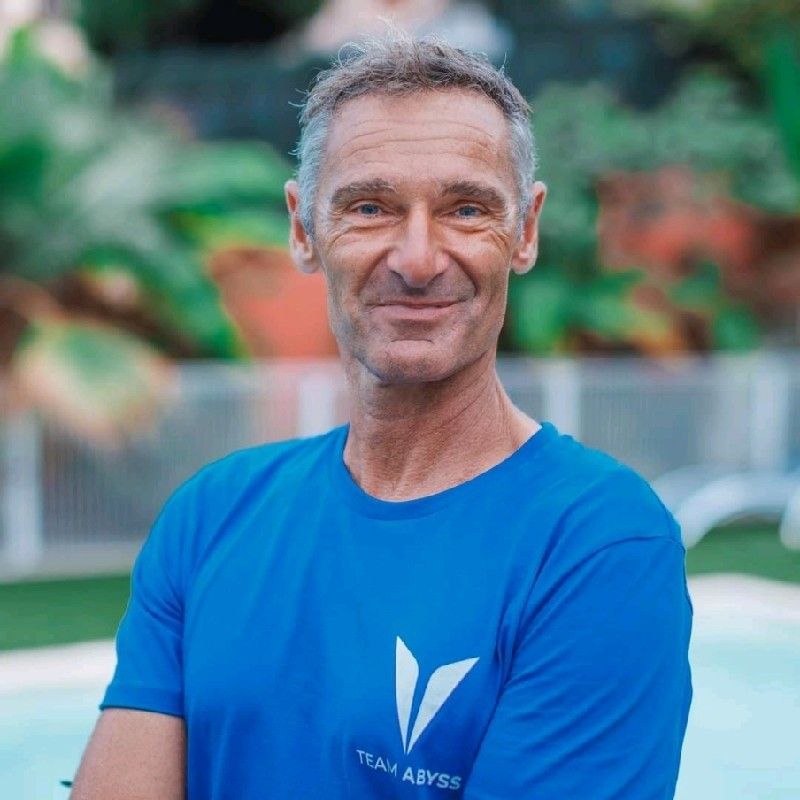
WRITTEN BY
Christian Vogler
Co-founder & Head Coach
Freediving Master World Champion 2022, former coach of the French national freediving team and co-founder of Apnea Lanzarote.